
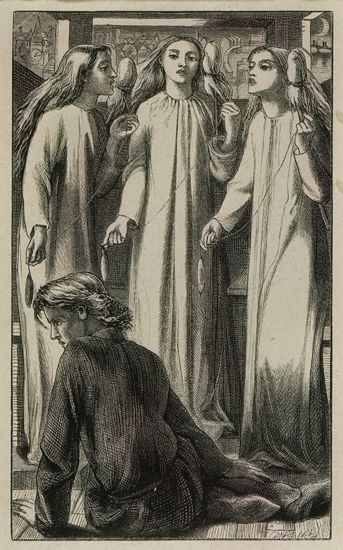
Dante Gabriel Rossetti’s first published illustration was The Maids of Elfen-Mere, drawn to illustrate a ballad by William Allingham titled “The Maids of Elphin-Mere”. The Rossetti Archive includes it in their collection note: “DGR’s illustration was made for Allingham’s ballad “The Maids of Elfin-Mere”, which was published in The Music Master, A Love Story, and Two Series of Day and Night Songs (1855) volume. It should be noted, however, that DGR employed a variant spelling–Maids of Elfen-Mere–for his design.”
Dante Gabriel Rossetti
The Maids of Elfin-Mere is a supernatural ballad, telling the tale of the nightly apparition of three ladies clad in white. They sing songs while they spin until eleven o’clock, the time when their apparition comes to an end and they disappear (Spinning to a pulsing cadence, Singing songs of Elfin-Mere; Till the eleventh hour was toll’d). They were loved by all, especially a Pastor’s son who develops a passion for them. (Most of all, the Pastor’s Son, Listening to their gentle singing, Felt his heart go from him, clinging Round these Maids of Elfin-Mere.) Like most of us, he could not be satisfied with what he had. The brief nightly visits were not enough, so he changed the time on the village clock. That night was their last visit. The Maids never returned and the only remnant of them was three bloodstains left in the lake (Saw at dawn three stains of gore In the waters fade and dwindle). The Pastor’s Son died broken-hearted and with regret. It is a sad, haunting tale. And in the faces of the Maids, we can see traces of Elizabeth Siddal’s features, for it was drawn by Rossetti in the mid 1850’s, a time when Lizzie’s image permeated his works. She too would die one night, never to return and left Rossetti to pine and regret and live with a guilt that would never leave. Once again we are left to note how often Rossetti’s life imitated his art in a sad and tragic way.
The Maids of Elfin-Mere by William Allingham
When the spinning-room was here
Came Three Damsels, clothed in white,
With their spindles every night;
One and Two and three fair Maidens,
Spinning to a pulsing cadence,
Singing songs of Elfin-Mere;
Till the eleventh hour was toll’d,
Then departed through the wold.
Years ago, and years ago;
And the tall reeds sigh as the wind doth blow.
Three white Lilies, calm and clear,
And they were loved by every one;
Most of all, the Pastor’s Son,
Listening to their gentle singing,
Felt his heart go from him, clinging
Round these Maids of Elfin-Mere.
Sued each night to make them stay,
Sadden’d when they went away.
Years ago, and years ago;
And the tall reeds sigh as the wind doth blow.
Hands that shook with love and fear
Dared put back the village clock,—
Flew the spindle, turn’d the rock,
Flow’d the song with subtle rounding,
Till the false ‘eleven’ was sounding;
Then these Maids of Elfin-Mere
Swiftly, softly, left the room,
Like three doves on snowy plume.
Years ago, and years ago;
And the tall reeds sigh as the wind doth blow.
One that night who wander’d near
Heard lamentings by the shore,
Saw at dawn three stains of gore
In the waters fade and dwindle.
Never more with song and spindle
Saw we Maids of Elfin-Mere,
The Pastor’s Son did pine and die;
Because true love should never lie.
Years ago, and years ago;
And the tall reeds sigh as the wind doth blow.
I love that poem! Some years ago, a Celtic band that was very big in my hometown in Santa Barbara put the poem to music and it was glorious. Unfortunately they never recorded it. I only ever heard them do it once, too, so I don’t even remember the tune, but I remember it was gorgeous.
You intrigued me. Elphin sems to be a common Celtic alternative spelling. Love the poem, haven’t read it for ages.
How beautiful ………thank you for sharing this today.
I only discovered the Pre-Raphelite brotherhood about ten years ago and I have been in love with Lizzie,though I have called her Lillith for so many years because I wasn’t sure of her name, I thought DGR had been married twice and so wasn’t sure which lovely lady was Lizzie and I forget the other lovely girls name but think it might be Jane. I memorised “The Blessed Damozel” when I was 12
and kept the book all these years until recently gave it to my granddaughter when she memorized another poem in it
“The Highwayman”, I had memorized that poem too, about the same time and from the same book a Rosetti’s poem. But since she was only in first grade, I thought she deserved to have the book. She is an avid reader as is my son, her father and if he had any ambition at all he could be a writer. My Mother was a published poet, though I felt her poetry very shallow. I have never had any interest in writing myself but it is a tradition from
my great grandmother on to write their memoirs. So, I will try my best to do that. It was interesting that someone knowledgable thought DGR and Lizzie were bi-polar
and I never knew that Rosetti went insane. I would like to know much more about that as it is a new and startling fact to me. I am not one who believes genius is only a hairsbreath from insanity. I am a psychotherapist and I
took this route from my earlier BS in English because I knew there was something wrong with me and I wanted to find out what. So, that I did, and no one other than myself has ever diganosed me, but no one has disagreed with me either that I am a high functioning bi-polar or I
wouldn’t have gone as far as I have in education, though,
now at the age of 74, will be 75 in October my memory is slipping badly. But I am such a lover of art and poetry
and sorry that it took me so long to find the pre-Raphlites. I also am a bead pattern designer who once finding Lizzie would love to do her face over and over.
I have also done her predecessor “Jane”? But I am one who
loves red hair, I fear I always make Lizzie’s hair redder than it was. Seeing some works like Millet’s “Ophelia”
where her hair doesn’t look red at all I was somewhat unaware that that was Lizzie, of course water darkens the hair and I have pondered over this picture for ages to try to see if I could see any resemblance to Lizzy. Is there any place on the net where I could find all of Rosetti’s paintings? If so could someone be kind enough to sent me that URL. I am very greedy, I want to see all that are in color. I try to copy them and bead them up for myself since portraits rarely sell well to the general public. Unless they are religious ones. I feel so fortunate to have found someone other than myself who is as into the pre-Raphlites as I am. I am an invalid who luckily got to travel to many museums before I landed in a wheel chair and cannot go any where but my 4 walls. My great sorrow is that when I was in England the same summer Fergie married, I was still unaware of the pre-Raphlites as that was some 24 years ago. The first two paintings I ever fell in love with were Monet’s “a Basket of Eggs” and one of the views of the Reims Cathederial”, hope I have the name of the right cathederal. I have never seen a copy of the basket of eggs but even though the eggs were white they were more colorful than any thing white I have ever seen, that is why when I did a copy of “Dance in the City” I made her white satin dress
in a way that I thought Monet might approve. The cathederal looked like it was made from crushed jewels.
Of course never having seen a Rosetti in person I find it easier to protray his work from photographs. My main wish in Life would be to see one of his finest pieces of art in person, and now that will never happen. A saddness
for me. I have decided to do what I like from now on even though it won’t well. Women’s Portraits! I think I am old enough for the last few months or years of my life just to blease myself. Only a few of the beaders know a
real work of art when they see it. Please let me know about Rosetti’s insanity.
Sincerely, Suz whi
I don’t think insane is the word I would use to describe Rossetti. But he developed some mental problems and grew increasingly morbid and depressed.
Artmagick.com has a wonderful Rossetti gallery and bio and Rossetti Archive is an excellent resource.
Tori Amos was inspired by this poem and the illustration. The song Maids of Elfen-Mere is on her latest album Unrependant Geraldines. You can listen to it here. http://www.youtube.com/watch?v=XC41gJINkJ4.