Pre-Raphaelite Sisterhood

Sitemap About Unexpected Pre-Raphaelite Sitings

The Maids of Elfin-Mere

Dante Gabriel Rossetti’s first published illustration was The Maids of Elfen-Mere, drawn to illustrate a ballad by William Allingham titled “The Maids of Elphin-Mere”.  I am unaware why Rossetti chose a different spelling of the title.  I’ve searched through several books and haven’t found anything more than passing mentions.  The Rossetti Archive includes it in their collection note: “DGR’s illustration was made for Allingham’s ballad “The Maids of Elfin-Mere”, which was published in The Music Master, A Love Story, and Two Series of Day and Night Songs (1855) volume. It should be noted, however, that DGR employed a variant spelling–Maids of Elfen-Mere–for his design.”

Dante Gabriel Rossetti by Julian Treuherz, Elizabeth Prettejohn, and Edwin Baker describes the problem that DGR had with this illustration saying that “This was Rossetti’s first published illustration, and he had a great deal of trouble with it, first failing to reverse it for the wood-block, and then complaining that the Dalziel brothers, who were responsible for the design on the wood, had ruined it in the process.  Nevertheless, the engraving was highly praised.  Burne-Jones considered it ‘the most beautiful drawing for an illustration I have ever seen’ “

The Maids of Elfin-Mere is a supernatural ballad, telling the tale of the nightly apparition of three ladies clad in white.  They sing songs while they spin until eleven o’clock, the time when their apparition comes to an end and they disappear (Spinning to a pulsing cadence, Singing songs of Elfin-Mere; Till the eleventh hour was toll’d).  They were loved by all, especially a Pastor’s son who develops a passion for them.  (Most of all, the Pastor’s Son, Listening to their gentle singing, Felt his heart go from him, clinging Round these Maids of Elfin-Mere.)  Like most of us, he could not be satisfied with what he had.  The brief nightly visits were not enough, so he changed the time on the village clock.  That night was their last visit.  The Maids never returned and the only remnant of them was three bloodstains left in the lake (Saw at dawn three stains of gore In the waters fade and dwindle).  The Pastor’s Son died broken-hearted and with regret.  It is a sad, haunting tale.  And in the faces of the Maids, we can see traces of Elizabeth Siddal’s features.  For it was drawn by Rossetti in the mid 1850′s, a time when Lizzie’s image permeated his works.  She too would die one night, never to return and left Rossetti to pine and regret and live with a guilt that would never leave.  So, once again we are left to note how often Rossetti’s life imitated his art in a sad and tragic way.

The Maids of Elfin-Mere by William Allingham

When the spinning-room was here
Came Three Damsels, clothed in white,
With their spindles every night;
One and Two and three fair Maidens,
Spinning to a pulsing cadence,
Singing songs of Elfin-Mere;
Till the eleventh hour was toll’d,
Then departed through the wold.
Years ago, and years ago;
And the tall reeds sigh as the wind doth blow.

Three white Lilies, calm and clear,
And they were loved by every one;
Most of all, the Pastor’s Son,
Listening to their gentle singing,
Felt his heart go from him, clinging
Round these Maids of Elfin-Mere.
Sued each night to make them stay,
Sadden’d when they went away.
Years ago, and years ago;
And the tall reeds sigh as the wind doth blow.

Hands that shook with love and fear
Dared put back the village clock,—
Flew the spindle, turn’d the rock,
Flow’d the song with subtle rounding,
Till the false ‘eleven’ was sounding;
Then these Maids of Elfin-Mere
Swiftly, softly, left the room,
Like three doves on snowy plume.
Years ago, and years ago;
And the tall reeds sigh as the wind doth blow.

One that night who wander’d near
Heard lamentings by the shore,
Saw at dawn three stains of gore
In the waters fade and dwindle.
Never more with song and spindle
Saw we Maids of Elfin-Mere,
The Pastor’s Son did pine and die;
Because true love should never lie.
Years ago, and years ago;
And the tall reeds sigh as the wind doth blow.


Jane Morris as Beatrice

Jane Morris as Beatirce

Although Rossetti painted Jane Morris repeatedly, it is a bit unusual to see her painted as Beatrice.  Beatrice, Dante Alighieri’s  unrequited love,  is a character Rossetti strongly associated with Elizabeth Siddal.   There is another painting of Jane Morris as Beatrice at The Rossetti Archive titled  The Salutation of Beatrice, also known as The Lady in the Blue Dress.

One thing I notice about this painting of Beatrice/Jane Morris is that it  is strikingly simple compared to other works by Rossetti during this time period.  His painting style had developed into large-scale works of female figures almost completely surrounded by flowers or ornament.  In contrast, Jane Morris appears here uncrowded and simply presented.

On a side note, we meet our old friend the spiral hair pin again in this painting!

hair adornment in rossetti paintings


The Keepsake

Painted in 1901, The Keepsake by Kate Bunce is based on Dante Gabriel Rossetti’s poem The Staff and Scrip.  The Staff and Scrip is a heroic and romantic tale of a pilgrim who finds himself in a land ruled by Queen Blanchelys.   The pilgrim is shocked by the state of this land and is told in the first stanza that the villainous Duke Luke has ‘harried them’.   The pilgrim makes his way to Queen Blanchelys, falls in love with her, and vows to defeat Duke Luke. In the course of defeating Duke Luke, the pilgrim loses his life.   His staff and scrip are kept by the Queen — hung over her bed as a tragic and romantic keepsake.

The Staff and Scrip

‘Who rules these lands?’ the Pilgrim said.
‘Stranger, Queen Blanchelys.’
‘And who has thus harried them?’ he said.
‘It was Duke Luke did this:
God’s ban be his!’

The Pilgrim said: ‘Where is your house?
I’ll rest there, with your will.’
‘You’ve but to climb these blackened boughs
And you’ll see it over the hill,
For it burns still.’

‘Which road, to seek your Queen?’ said he.
‘Nay, nay, but with some wound
You’ll fly back hither, it may be,
And by your blood i’ the ground
My place be found.’

‘Friend, stay in peace. God keep your head,
And mine, where I will go;
For He is here and there,’ he said.
He passed the hill-side, slow,
And stood below.

The Queen sat idle by her loom:
She heard the arras stir,
And looked up sadly: through the room
The sweetness sickened her
Of musk and myrrh. [Read more →]


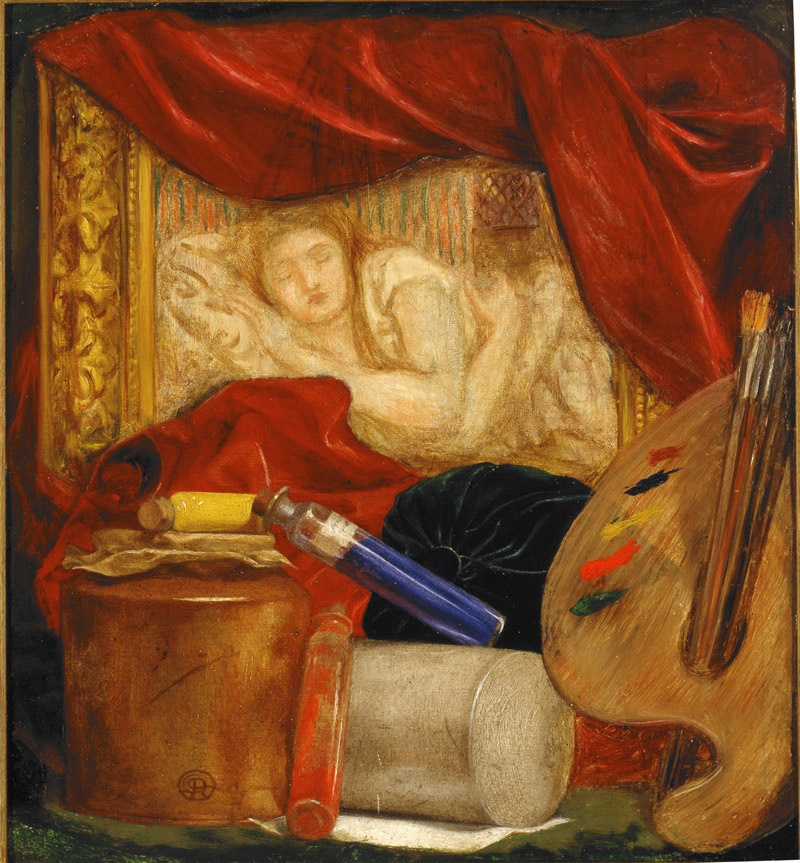
Study for Fair Rosamund

The more I study the Pre-Raphaelites, the more I discover that I often prefer the artist’s studies rather than the paintings themselves.  Although I love Fair Rosamund, I find the study has a sad and intimate feel that isn’t quite captured the same way in Rossetti’s finished product.  Here is Dante Gabriel Rossetti’s study for Fair Rosamund with Fanny Cornforth as the model:

Rossetti, study for Fair Rosamund

And Rossetti’s portrait Fair Rosamund:


For more on the story of Fair Rosamund see the post Fair Rosamund and Queen Eleanor which features the painting of the same name by Sir Edward Coley Burne-Jones.  The jewelry in this painting is also mentioned in one of my favorite entries that I’ve written for this site:  Rossetti and His Baubles.


The Wine of Circe by Edward Burne-Jones, Poem by Dante Gabriel Rossetti

The Wine of Circe, painted by Sir Edward Coley Burne-Jones.   Dante Gabriel Rossetti wrote a sonnet inspired by this painting, which you can read a great deal of background on at The Rossetti Archive:

DGR wrote the sonnet for the express purpose of having “some record of [Burne-Jones'] work in my book [i.e., in the 1870 Poems],” as he told Barbara Bodichon. “I have tried in the first lines to give some notion of the colour, and in the last some impression of the scope of the work,—taking the transformed beasts as images of ruined passion—the torn seaweed of the sea of pleasure. You will remember that in the picture the window shows a view of the sea and the galleys which bear the new lovers and victims of the enchantress” (see DGR’s letter of 15 March 1870, Fredeman, Correspondence, 70. 53 ). DGR’s interest in the colour dynamics of Burne-Jones’ painting reflects his awareness of the problematic character of both beauty and pleasure. That awareness is a constant theme in his work—indeed, is perhaps his predominant theme.

One thing I love about Rossetti’s works is that he demonstrated a strong link between poetry and painting. Not only did he write sonnets to accompany many of his own works, he wrote poems for paintings by other artists. Looking through the table of contents of my book of Rossetti’s poems I see poems written for Our Lady of the Rocks by Da Vinci, a Venetian Pastoral by Giorgione, an Allegorical Dance of Women by Andrea Mantegna, Ruggiero and Angelica by Ingres and more.


For “The Wine of Circe” By Edward Burne-Jones


DUSK-HAIRED and gold-robed o’er the golden wine
She stoops, wherein, distilled of death and shame,
Sink the black drops; while, lit with fragrant flame,
Round her spread board the golden sunflowers shine.
Doth Helios here with Hecaté combine
(O Circe, thou their votaress!) to proclaim
For these thy guests all rapture in Love’s name,
Till pitiless Night give Day the countersign?
Lords of their hour, they come. And by her knee
Those cowering beasts, their equals heretofore,
Wait; who with them in new equality
To-night shall echo back the sea’s dull roar
With a vain wail from passion’s tide-strown shore
Where the disheveled seaweed hates the sea.

I’ve also scanned the poem from my own volume of Rossetti’s works because it represents my favorite reading experience:  a beautiful hardcover book with gilt edged pages, that certain typeset from yesteryear, and a slightly musty yet welcoming smell.  I’m not sure how old my volume is, but it was published by Hurst & Co. which existed between 1871 and 1919.


Circe Invidiosa

Circe Invidiosa, John William Waterhouse

Waterhouse is an adept at blending feminine beauty and mystery.  Here he depicts the goddess Circe amidst shades of greens and blues, creating a world that draws us in and mesmerizes.   If you really look at this painting, you can feel yourself transported into Circe’s world:  you can hear the water echoing through a secluded grotto.  It is dark.  Calm and cool.  And it is beautiful. Not a passive beauty, but a powerful beauty born of Circe’s focus and intensity.

The goddess Circe is mentioned in Homer’s Odyssey and in Hesiod’s Theogeny, as well in other ancient Greek writings.  She is a goddess of magic and metamorphosis:

KIRKE (or Circe) was a goddess pharmakeia (witch or sorceress) who lived with her nymph attendants on the mythical island of Aiaia. She was skilled in the magic of metamorphosis, the power of illusion, and the dark art of necromancy. When Odysseus landed on her island she transformed his men into animals, but with the help of the god Hermes, he overcame the goddess and forced her to release his men from her spell. Kirke’s name was derived from the Greek verb kirkoô meaning “to secure with rings” or “hoop around”–a reference to her magical powers. (Via Theoi.com)

It is Waterhouse’s simplicity that I admire in this painting. We are not distracted by background scenes. It is all about Circe. Waterhouse has chosen to depict Circe in a scene from Ovid’s Metamorphoses:

Having tried without success to lure the deity Glaucus away from the object of his affection the beautiful nymph Scylla, Circe is filled with envious rage. In the seclusion of a quiet grotto, she poisons the water where Scylla goes to bathe and turns her rival into a dreadful sea monster. Waterhouse’s handling of the scene is brilliantly economical. With grim determination, Circe empties a bowl of green poison into the waters, half hovering, half standing on the already transformed Scylla, who writhes beneath the surface. Her waist-length hair, meanwhile billows up and out, as if disturbed by a rush of deadly vapours” (Trumble, Angus. Love and Death in the Age of Queen Victoria. Adelaide: Art Gallery of South Australia. 2002.)


21st Century Stunner

I am thrilled to share this new blog with you — it is one that I’m sure will become a frequent destination of mine since finding ways to combine Pre-Raphaelite elements with contemporary fashion has become a goal of mine. So it is quite timely that The 21st Century Stunner: Pre-Raphaelite Style for the Modern Woman has been created!

Welcome to 21st Century Stunner, a blog for women with an interest in Pre-Raphaelite style, both modern and antique, as well as Artistic / Aesthetic dress and accessories.  This blog is primarily for enjoyment and not meant to be a historical compendium, although scholarly discussion is welcome.  It is my hope that this can be a gathering place of women who like to cultivate a modern Pre-Raphaelite look.


← Before