
The tale of Pygmalion dates back to Ovid’s Metamorphoses
Pygmalion is a sculptor who is disgusted by the behavior of local women, who are frivolous, shallow, and immoral. His decision to live a life of celibacy instead of choosing one of these women shows his level of disgust. Pygmalion was fed up. What he desired in a partner could not be found in a local woman and he would not settle for less. He can not give up his dream.
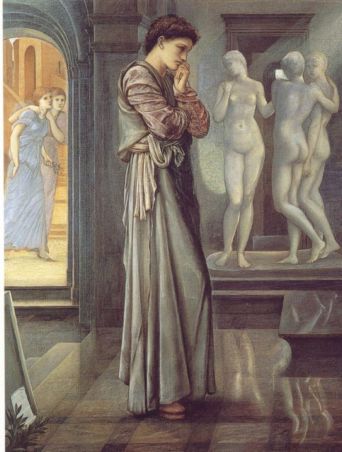
Burne-Jones introduces us to Pygmalion in the first painting, Pygmalion and Galatea I: The Heart Desires. He stands in contemplation. His back turned to the living women in the doorway. He’s not looking at the women depicted in statue either (the statues are the three graces, by the way). But look at the floor. We can see, reflected, an array of body parts…posterior, thighs, etc. Pygmalion does not look at these. He ignores the living women, the statues of women, the reflection of femininity. Instead, we can assume that he is thinking of the perfect woman that exists only in Pygmalion’s head, the woman that he shall soon sculpt.
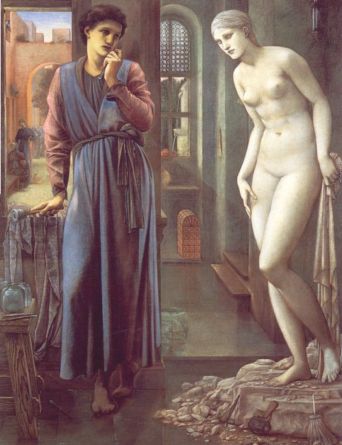
In the second picture of the series (Pygmalion and Galatea II: The Hand Refrains), we see Pygmalion has been busy at work. In the doorway, we can still see local women in the distance, the real, flesh and blood women that Pygmalion has disdained. He has created the woman of his dreams, his perfect woman. He admires her now, all the hard work is done. We can see his tools at the base of the statue. He has created her and he loves what he has created.
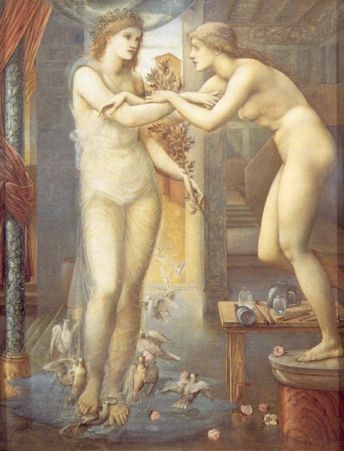
According to Metamorphoses, Pygmalion prays to the goddess Aphrodite, hoping she will bless him with a wife that will be just as wonderful and perfect as his statue. This was a bold step for the sculptor, as he had essentially shunned Aphrodite in the past. So we see in the third painting of the series (Pygmalion and Galatea III: The Godhead Fires) that Aphrodite has visited Pygmalion’s statue. Their arms entwined, we now see the presence of doves and flowers that were never present in the studio before. The goddess has brought life into the studio, and to Galatea (Pygmalion’s creation).
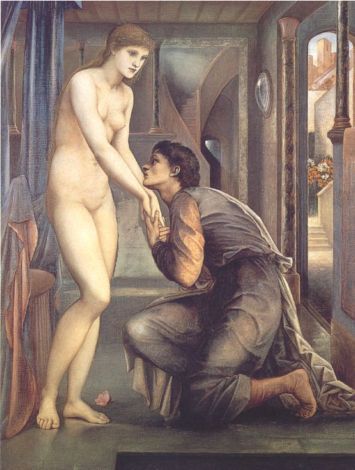
In the final picture (Pygmalion and Galatea IV: The Soul Attains) Pygmalion discovers that his statue has come to life. His prayers to Aphrodite have been heard and granted. He kneels at her feet, apparently grateful that his ultimate dream has come true.
Famously, the Pygmalion story was the inspiration of George Bernard Shaw’s play Pygmalion which in turn was the basis for the musical My Fair Lady.
And who was the model for Pygmalion’s statue, the “dream woman”? Maria Zambaco, with whom Burne-Jones had quite a famous affair. Interestingly, Zambaco herself was a sculptor. You can see a study that Burne-Jones sketched of Maria at the Birmingham Museums & Art Gallery website. This entire series of Pygmalion paintings was commissioned by Euphrosyne Cassavetti, Maria Zambaco’s mother.
Notice that with the titles of the paintings, Burne-Jones has created a poem:
 The heart desires
 The hand refrains
 The godhead fires
 The soul attains.
Victorian Web Article: Burne-Jones’s Departure from Ovid in the Pygmalion Series
Overview of George Bernard Shaw’s Pygmalion at Literary Encyclopedia
Or read it at Project Gutenburg
Ovid’s Metamorphoses
Check out this George Bernard Shaw DVD collector’s set
I’ve seen this set of paintings a couple of times. Their home is in the Birmingham Museums and Art Gallery, UK. It’s a beautiful set. I agree with you Stephanie. My favourite of the four is also the third picture illustrated; The Godhead Fires. Burne Jones did many stunning pencil studies of Maria Zambaco. If I was asked what my favourite drawing of all time is….it’s one of EBJ’s beautiful pencils of Maria I saw temporarily on show in a gallery in Hampstead near London. The drawing had faded but the quality was stunning; jewel-like.
Such beautiful paintings. They are positively exquisite! I just love Burne-Jones. And I didn’t know he’d had an affair with the model! For some reason I always enjoy gossip that’s more than a hundred years old. It’s probably why I’m a historian! Anyway, great post, and thank you for the shout out in your previous post.
Hope you had a great weekend,
Meggie
I actually felt a little guilty writing about his affair with Maria Zambaco, because I’ve always loved his wife Georgie so much! He had great difficulty ending the affair from what I understand, she did not want to let go. Sometimes I feel like I’m snooping on people’s private affairs, only to remind myself that this happened long, long ago.
I love the third painting for the reasons you mentioned. But the first painting is intriguing as well, with the reflections of the statues on the floor and the sculptor in deep contemplation. I love this series.
Dying to read it. You will let me know if you hear of a US release, yes?
I emailed the publisher a few days ago; I’ll let you know what I find out!
I recently found her long article on BJ by Fiona on the Tate site
http://www.tate.org.uk/tateetc/issue12/visionaryoddity.htm
Thank you Philip — I had not read this article before. I’m looking forward to her book.
I also like that she shared the first Burne-Jones paintings that she was drawn to. I always like knowing what Pre-Raphaelite painting first ‘hooks’ a person! Quote from her article: “I have loved Burne-Jones’s work ever since I saw King Cophetua and the Beggar Maid (1884) on a visit to Tate with my mother as a child of nine or ten. Later, in an exhibition in Sheffield, I came face to face with another of his wonderfully enigmatic compositions, The Golden Stairs (1880) “
If it helps and you may have noticed on my blog – Millais was my first love and still is – not sure what I saw first in the Tate.
lol bmega lol I like it it s amazing
Yes Exactly
I am impressed by the III painting. I being a student of Eglish Literature ,nowadays headind Cognitive Science Department in a public sector university was keen to read more about the myth and see some paitings. I am pleased now to have seen these paintings of Pygmilion and Galatea.
I believe that the architect, designer William Arthur Smith Benson (1857-1924) was the model for the head of Pygmalion. His biography and details of his multitude of designs in metal (lighting, hollow ware), wood (furniture), and architectural output are contained in ‘WAS Benson: Arts and Crafts Luminary and Pioneer of Modern Design’, I Hamerton (Ed.) Antique Collectors’ Club: Woodbridge, 2005.