
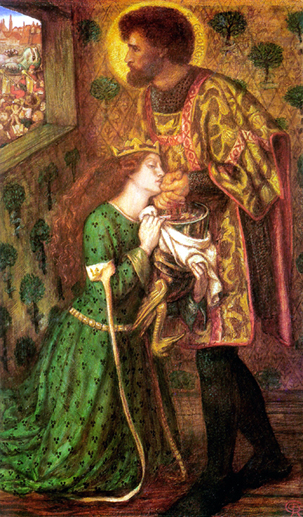
St. George and the Princess Sabra was painted by Dante Gabriel Rossetti in 1862. This was the last work that his wife, Lizzie Siddal, posed for before her death. I find myself searching her face, as if it were a photograph, looking for signs of what was to occur days later: her overdose of laudanum.
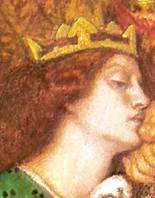
The Model:
In 1849, Elizabeth Siddal was working at Mrs. Tozer’s hat shop when she was introduced to the artists of the Pre-Raphaelite Brotherhood.
It was the charismatic artist and poet Dante Gabriel Rossetti who not only drew and painted her obsessively, but encouraged Lizzie in her own artwork and poetry. Their relationship was intense and rocky, with an informal engagement that lasted on and off for a decade.
Sadly, their marriage was short. The couple suffered a stillborn daughter and Lizzie, in frequent ill-health,became dependent on laudanum. She died in 1862 of an overdose.
The rest of Lizzie’s tale is famous for its macabre nature: in his grief, Gabriel buried his only manuscript of his poems with Lizzie. The poems, nestled in her coffin next her famous copper hair, haunted him. Seven years later, he had her coffin exhumed in order to retrieve the poems for publication.
The story was spread that Lizzie was still in beautiful, pristine condition and that her flaming hair had continued to grow after death, filling the coffin.
This, of course, is a biological impossibility.
Cellular growth does not occur after death, but the tale has added to Lizzie’s legend and continues to capture the interest of Pre-Raphaelite and Lizzie Siddal enthusiasts.
Unfortunately for Elizabeth Siddal, she lived in a time where addiction was a taboo subject and little was known about post-partum depression. She lived within a cycle of illness, addiction, and grief with no useful resources available to her. Although she pursued a creative outlet while most women were denied modes of self expression, Lizzie was never able to move beyond the addiction that eventually claimed her life.
The Subject Matter:
The story of St. George was not a new subject for Rossetti. He designed a set of stained glass windows to be created by the Morris firm. Previously, in 1857, he had painted The Wedding of St. George.
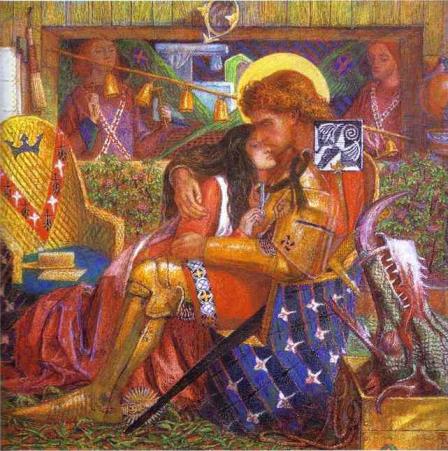
Here we can see the triumphant St. George embracing Princess Sabra, both of them seemingly oblivious to the dead dragon.
The story of St. George was a legend handed down from the Crusaders and was printed in 1483 by Caxton in a book called The Golden Legend. St. George happened upon a town with a horrible dragon. The townspeople had been feeding the dragon sheep in order to keep it at bay. In another version of the myth, they fed the dragon their children who were chosen according to a lottery. They also gave the dragon young virgins.
St. George attacks and slays the dragon, saving the city. He is rewarded with Princess Sabra’s hand in marriage.
Links:
St. George and the Princess Sabra at The Rossetti Archive
St. George, England’s Patron Saint at Assignmentbro.com
Catholic Encyclopedia: St. George
Burne-Jones also illustrated the story of St. George
The Tate Collection: Rossetti’s St. George and the Princess Sabra
Gorgeous images, Stephanie! I haven’t seen these in such vivid colors before!
The tongue hanging out of the dragon’s mouth has always struck me as humorous, although I’m sure Rossetti didn’t intend it to be. It just looks so much like my dog when he sleeps on his back.
Thank you so much for posting this, Stephanie. I don’t think I’m very familiar with this piece (the 1857 one, yes, I know that one quite well & for a long time I felt that it was really Lizzie’s work, not Gabriel’s — & perhaps it was, at least in part –certainly looks to me like hers), and I had no idea that it (this 1862 watercolor)was created just before Lizzie’s fatal OD.
Very, very haunting, indeed.
….but then, if I had been paying attention & noticed the 1862 date, I would have (hopfully) figured it out…
https://bbsradio.com/article/