Pre-Raphaelite Marriage: Ruskin, Effie and Millais

John Ruskin was an accomplished fellow.  This paragraph from Wikipedia illustrates the depth of his interests and works:  … leading English art critic of the Victorian era, also an art patron, draughtsman, watercolourist, a prominent social thinker and philanthropist. He wrote on subjects ranging from geology to architecture, myth to ornithology, literature to education, and botany to political economy. His writing styles and literary forms were equally varied. Ruskin penned essays and treatises, poetry and lectures, travel guides and manuals, letters and even a fairy tale. The elaborate style that characterised his earliest writing on art was later superseded by a preference for plainer language designed to communicate his ideas more effectively. In all of his writing, he emphasised the connections between nature, art and society. He also made detailed sketches and paintings of rocks, plants, birds, landscapes, and architectural structures and ornamentation.

Sounds like a great catch, right?  Not so for  Euphemia Chalmers Gray, known as Effie.  The thought of Effie and what she must have gone through as his wife is thoroughly depressing. And so very odd.  Ruskin was obviously intelligent but apparently he lacked a knowledge of female anatomy and rejected Effie on their wedding night on the premise that he was shocked by her appearance.  Their marriage remained loveless and without physical interaction.  Effie wrote to her father, “He alleged various reasons, hatred to children, religious motives, a desire to preserve my beauty, and, finally this last year he told me his true reason… that he had imagined women were quite different to what he saw I was, and that the reason he did not make me his Wife was because he was disgusted with my person the first evening 10th April.”   

Ruskin was a supporter of the Pre-Raphaelite Brotherhood and formed a friendship with artist John Millais.  Effie appears in his painting The Order of Release and perhaps it was then that feelings for each other were born.  The trio later traveled to Scotland so that Millais could paint Ruskin’s portrait.  In a move that shocked Victorian society, Effie abandoned her travesty of a marriage to pursue happiness with Millais.

It was a shocking scandal.  All of the details of Effie’s marriage were made public and she was even forced into the humiliating experience of having a doctor confirm her virginity.  I think that her later life was a happy one.  She and Millais had eight children and settled into a loving family life.  Sadly, though, her annullment resulted in Effie’s becoming socially ostracized and was no longer invited to may social functions.

Effie’s saga is being revisited through Emma Thompson’s latest film project.  And like Effie’s life, it is not without scandal.  Plagiarism accusations have been leveled towards both Thompson and her husband, Greg Wise.  Also surprising is the casting of Effie’s role, to be portrayed by American Dakota Fanning instead of the obvious choice of a British actress.  This is not the first time the affairs of Ruskin, Effie and Millais has played out on the big screen.  A silent film, The Love of John Ruskin, was produced in 1912.

The strange relationships of John Ruskin do not end with Effie.  He later had an obsessive relationship with a very young Rose La Touche, whom he met when she was nine.  Nine.  Yes, that is definitely material for a future post.

Posted in Millais | Tagged , , , | 7 Comments

Pre-Raphaelite Marriages: Dante Gabriel Rossetti and Elizabeth Siddal

Writing on the Sand, Dante Gabriel Rossetti

I’ve spent years reading about the relationship between Dante Gabriel Rossetti and Elizabeth Siddal.  One thing I’ve noticed through comments and emails I receive at lizziesiddal.com is that there are a lot of people who are so sympathetic towards Lizzie that they passionately hate Rossetti.  When you learn about people, I think a story forms in your head and it’s easy to cast them as villains or saints.  We like to have someone to root for and someone to vilify.  Even though I am obsessively interested in Lizzie Siddal, I simply can’t bring myself to dislike Rossetti.  He intrigues me.  I do not approve of  some of his choices.  He was complex and deeply flawed.  But good lord, could that man paint a goddess:

Proserpine by Dante Gabriel Rossetti, model Jane Morris

Lizzie was discovered by artist Walter Howell Deverell while she was working in a millinery shop and appears in his painting Twelfth Night.  This introduction to the Pre-Raphaelite circle led to her appearance in several works such as Ophelia by Millais and Valentine Rescuing Sylvia by Holman Hunt.  Eventually, she posed only for Dante Gabriel Rossetti.

Twelfth Night by Walter Howell Deverell

Lizzie sat exclusively for Gabriel and he drew and painted her image obsessively.  Again and again he captured her likeness.  When she expressed an interest in creating art instead of just posing for it, he became her mentor.  This is the part of their relationship that I most enjoy, I like the idea of a couple inspiring each other artistically and creating together.  Gabriel encouraged and supported her work, even helping to secure John Ruskin as her patron.

Elizabeth Siddal drawn by Dante Gabriel Rossetti

Pippa Passes drawn by Elizabeth Siddal

All of this seems promising, a couple who loves each other and whose lives revolve around their art.  Where did it go wrong?  At some point, Lizzie developed a reputation for being in ill-health and began to use Laudanum, which was quite common at the time.  It’s also apparent that Rossetti had placed her on a pedestal, she was someone to be loved from afar, idealized and admired as an artistic muse and not as a flesh and blood woman.  His sister, the poet Christina Rossetti, alludes to this in her poem In An Artist’s Studio:

One face looks out from all his canvasses,
One selfsame figure sits or walks or leans;
We found her hidden just behind those screens,
That mirror gave back all her loveliness.
A queen in opal or in ruby dress,
A nameless girl in freshest summer greens,
A saint, an angel; – every canvass means
The same one meaning, neither more nor less.
He feeds upon her face by day and night,
And she with true kind eyes looks back on him
Fair as the moon and joyful as the light:
Not wan with waiting, not with sorrow dim;
Not as she is, but was when hope shone bright;
Not as she is, but as she fills his dream.

Their on and off relationship lasted close to a decade before they finally married.  Prior to marriage, there had been troubles.  It seemed Rossetti had been infatuated with model Annie Miller, who was involved with artist William Holman Hunt.  Lizzie developed a dislike towards both Annie and Holman Hunt.  Both Lizzie and Rossetti were moody and temperamental, which no doubt added to their friction.  The relationship must have been dizzying, he could shift between neglectfulness due to his attentions towards other women to being suddenly attentive and rushing to her side when she was ill.  And since she was so often ill — and so often recovered — it has been suggested that at times her illness was an attempt to manipulate Rossetti and play upon his sympathies. He later discovered both Fanny Cornforth and Jane Burden (later Morris).  I can’t say to what level his intimacy with them reached at this point in his life, but he was definitely captivated and Lizzie’s position as his only muse had been altered irrevocably.  She still remained a muse, but it was now a title she would share with more than one woman.

There were many times during their courtship when they endured separations:  she traveled for her health and once even attended an art school in Sheffield, which shows that she was serious in her pursuits and that her artistic endeavors did not exist only in relation to Rossetti.  Eventually though, her illnesses were more real than ever.  No longer manipulations, but serious physical problems that most likely stemmed from her extensive Laudanum use.  The alcohol/opiate derivative had taken its toll.

In 1860, Lizzie was staying in Hastings and was so ill that her family believed her to be dying.  Rossetti was summoned to her side.  He’d seen her ill many times before, but this time there must have been a sense of great urgency because finally he was ready to marry her.  Together they had a history of nine years.  Nine years of creating art, fueling their creativity, fighting passionately over various things and I’m sure that all of that history fed his desire to rescue Lizzie and to do that noble thing that he always said he intended to do.  He married her.

The Rossetti marriage was fated to last two years.  Despite her illness, they were able to make it to Paris for their honeymoon.  Their marriage was spent pursuing artistic endeavors and spending much time with fellow artists Burne-Jones and William Morris.  Rossetti and his bride contributed a great deal to the decorating of Morris’s Red House and I can picture that time as one filled with joy and creativity, a time of new beginnings and possibilities.

Sadly, Lizzie was still hopelessly addicted to Laudanum.  She became pregnant and their joy for upcoming parenthood was quickly dashed as grief set in when she lost the baby.  Their daughter was stillborn, quite likely because of Laudanum.  Lizzie was distraught, caught in a world of depression, grief and addiction.  Lucinda Hawksley describes this period in Lizzie Siddal:  The Tragedy of a Pre-Raphaelite Supermodel:

Following the loss of her child, Lizzie was permanently altered.  She would sit in the drawing room for hours without moving her position, just staring silently into the fire.  If there was no fire, she would simply stare into space, apparently not seeing anything in front of her.  Once she refused to eat and became increasingly emaciated.  The nurse hired as a maternity carer was living with them and taking care of her, but Lizzie was too wrapped up in grief to be aware of anything except her loss.  When Ned [Burn-Jones] and a heavily pregnant Georgie [Burne-Jones] came to visit her, Lizzie was in her room alone, staring at the empty baby’s cradle, which she would rock tenderly from side to side as though soothing her daughter to sleep.  As the door creaked open she looked up and told them to be quiet so as not to wake the baby.  The pregnant Georgie found this heart-rendingly sad; Ned thought Lizzie was being ridiculously over-dramatic.


I almost can’t bear how sad that is, the image of Lizzie rocking an empty cradle, the ghost of a child.  It’s interesting to see the differing reactions of Burne-Jones and his wife.  Georgie instantly feels compassion for Lizzie while Ned feels it to be needless melodrama.  Different gender reactions and levels of understanding towards emotional issues seems to be a recurrent theme of the time. Well, of many times since it’s not something limited to the Victorian era.   Women swoon, men carry on with a stiff upper lip.  When she later became pregnant again, who knows what her emotional states must have been?  Still an addict and not fully recovered from the previous tragedy, she must have been in a precarious emotional state.  On February 10, 1862 pregnant Lizzie, Rossetti, and poet Algernon Swinburne dined together.  Later that evening, Rossetti had an engagement at Working Men’s College.  When he returned, she was in a coma due to an overdose of Laudanum.  He summoned a doctor and when Rossetti was unable to accept that the doctor could not save her, he summoned three more.   Lizzie passed away in the early hours of February 11, 1862.

Most descriptions of Lizzie state that she committed suicide.  I do not believe it was purposeful.  Of course it was self-inflicted as all addict’s deaths are once they have spiraled out of control.  But I don’t believe Lizzie set out to kill herself and though there are documented stories of a destroyed suicide note, it seems to be hearsay that we can’t possibly prove.

Lizzie’s image continued to haunt Rossetti after her death.  He memorialized her in his painting Beata Beatrix, a tribute to Lizzie that incorporates a poppy flower being delivered to her hands by a dove.  Opium is derived from poppies; the dove delivers to her the very source of the ingredient that killed her.

Beata Beatrix, Dante Gabriel Rossetti

The Rossetti marriage was cemented into literary and art history by the macabre act of having Lizzie’s grave exhumed seven years after her death so that Rossetti could retrieve the manuscript of poems that he had buried with her.  In my opinion, it was a terrible thing to do.  Although, without that act many people would not know who Lizzie Siddal was — it is so strange and fascinating that when people read of it, they are compelled to find out more about her.  I have experienced that compulsion.  It was the beginning of my journey to learn all I could about Lizzie and her life and work.

I said in my previous post that Pre-Raphaelite marriages were strange.  As I write this one, I realize that the Rossetti marriage wasn’t strange, it is just hopelessly sad.  So many missed opportunities.  I feel sad for both of them, that neither of them seemed to get what they wanted out of their relationship.  They seem troubled and tragic.

I end this with Elizabeth Siddal’s own words:

Gone

To touch the glove upon her tender hand,
To watch the jewel sparkle in her ring,
Lifted my heart into a sudden song
As when the wild birds sing.

To touch her shadow on the sunny grass,
To break her pathway through the darkened wood,
Filled all my life with trembling and tears
And silence where I stood.

I watch the shadows gather round my heart,
I live to know that she is gone

Gone gone for ever, like the tender dove
That left the Ark alone.


Posted in Dante Gabriel Rossetti, Elizabeth Siddal | Tagged , , | 17 Comments

Pre-Raphaelite Marriage

Effie Ruskin (later Millais) appears in The Order of Release by Sir John Everett Millais

There has been a lot of talk about Emma Thompson’s new movie Effie, which covers the sad and unusual marriage of Victorian art critic John Ruskin and his wife Effie, who scandalously divorced him to marry Pre-Raphaelite artist John Millais. Ruskin and Effie were married for several years before she divorced him, and when they divorced she was still a virgin.  It occurred to me that I should write a post about Effie’s story because it has come to my attention lately that I have a lot of visitors that are new to the fascinating history of the Pre-Raphaelites. I’ve noticed that much of what I write is under the assumption that people who make their way to this blog have at least some knowledge already about the Pre-Raphaelites and perhaps that is a mistake on my part.

As I pondered a post about Effie, I said to myself, “You know what? Pre-Raphaelite marriages are strange.”  The story of Effie, Ruskin and Millais is scintillating and unusual.  Ruskin was decidedly one weird dude, but you can’t look at the strangeness of the tale as an isolated incident because for a relatively small group of people, the Pre-Raphaelite circle has some huge personal issues.

So Pre-Raphaelite marriages will be my theme for the week. I started to write one long post about it, but it’s a daunting task.  I’ll tackle each couple individually with the first post appearing tomorrow.  To think about it, I find it quite funny that  I would never judge or discuss a contemporary couple’s marriage since I have a live-and-let-live attitude and am not interested in what goes on behind close doors.  But apparently if you lived 150 years ago and your marriage was slightly outside the norm and had even the slightest whiff of scandal,  I am fascinated and will pick you apart with glee.


Posted in Millais, Site Related | Tagged , , | 23 Comments

New Year, New Project

I am exhausted. On a whim, I decided to paint my living area and kitchen red. I’ve always wanted red walls. I think they are bold and artistic and for me it represents a creative outlook that I’m trying to indulge in my life. But, good grief does my back ache right now. I am literally standing in the midst of chaos. I’m no where close to finished, but I was able to rehang some prints in my first dry corner. It’s nice to see progress. And doesn’t Ophelia look perfect against red?

Posted in Personal | 10 Comments

Watch out for Stunner

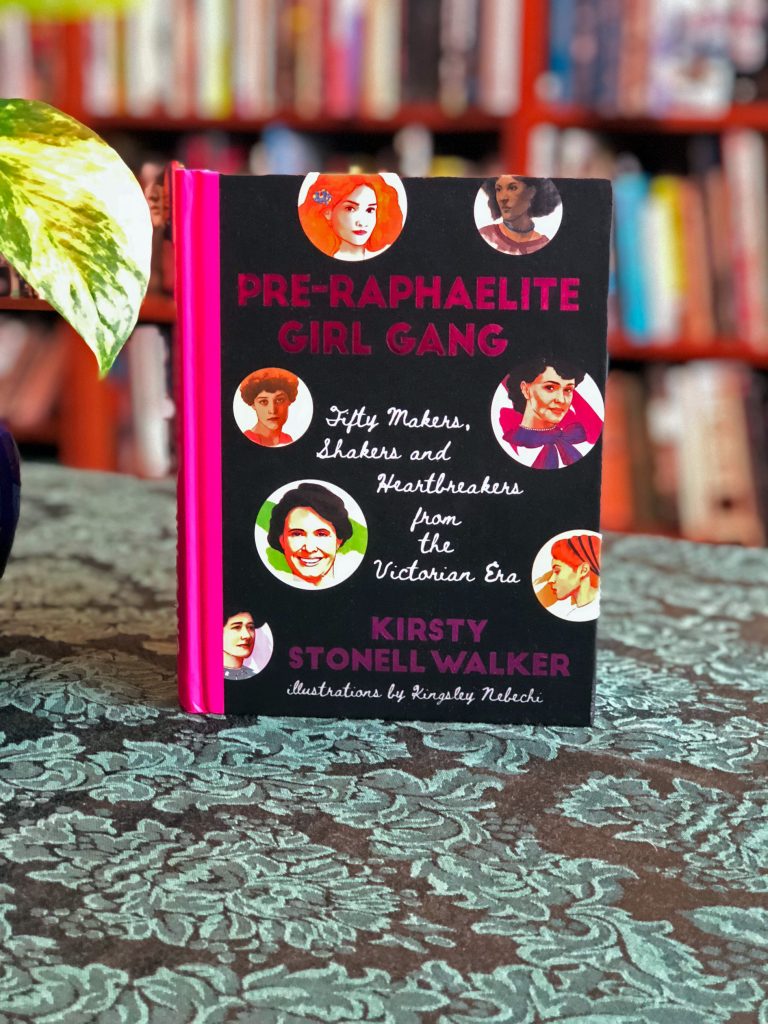
Before Christmas, Kirsty Stonell Walker sent me her revised manuscript of Stunner to read.  People, it is awesome.  I’m not sure when the projected release date will be, but as soon as it is out I urge all Pre-Raphaelite enthusiasts to snap up a copy.

Stunner is the first full-length biography of Pre-Raphaelite artist’s model Fanny Cornforth. Fanny has been repeatedly dismissed and overlooked by biographers and art historians since scholarship of the Pre-Raphaelite Brotherhood began. When I first started to research the life of Elizabeth Siddal, I had definite opinions about Fanny which were mainly formed by these dismissive accounts of her. Enter Kirsty, keeper of Fanny’s flame. Kirsty cares for Fanny, you can sense that through her writing. But she does not idealize. She presents Fanny openly and honestly and with a discerning eye.

As soon as Stunner is available for purchase, I’ll let you know. But keep your eye out for Kirsty. She has a Pre-Raphaelite novel in the works. Anything she writes will have a permanent place on my shelves.

Fanny Cornforth in Dante Gabriel Rossetti's Bocca Baciata

Posted in Books, Fanny Cornforth | 14 Comments

Happy 2012!

There is a wealth of possibility in beginnings, especially the beginning of a new year.  Since I see beginnings as positive, I think it’s dreadful if we add anything negative to that. I never form New Year’s Resolutions that have anything to do with subtraction.  No eating less, no shedding pounds, no pining or wishing desperately for something in our lives to be different. I firmly believe that if we participate in that world of resolutions, then we should embrace resolutions that involve more.  More laughter, more love, more goodness, more reading.  All it takes is the effort to pursue those moments where we allow ourselves to slow down physically or mentally, to quiet our minds and our worries and just enjoy the moment we’re in.  That’s not always an easy thing to do, which is what makes it so wonderful when we can actually pull it off.

Since this is my first post of the year, I thought I should begin with a painting that I find meaningful.  Evelyn de Morgan’s Hope in the Prison of Despair.  De Morgan’s works are often allegorical and I’m drawn to the beauty and symbolism of her pieces.  This one is perfect for a new year, I think.  It tells us that we can move on from the past, the chains of thought that bind us.  Hope lives in the prison of despair.  Despair and hope, we all have both in abundance.  The key is, and I’m sorry if all of this sounds cliche, we have to work through that despair to set that hope free and embrace it.

When I think of despair, I remember this quote from Agatha Christie.  I love this, it describes how I feel about my life:
“I like living. I have sometimes been wildly, despairingly, acutely miserable, racked with sorrow, but through it all I still know quite certainly that just to be alive is a grand thing.”

Posted in Evelyn De Morgan, Site Related | Tagged , , | 17 Comments

Listen to Possession on BBC Radio 4

Thank you to Prabal K. Ray for letting me know that an adaptation of A.S. Byatt’s book Possession is currently on BBC Radio 4.  Those of us outside the UK are able to listen to it as well.  There are 7 days left to listen to episode 1.

Possession is one of my favorite and dearly loved books, which I’ve mentioned here and here.  If you also enjoy it, I recommend reading A.S. Byatt’s  Little Black Book of Stories.  I can read The Thing in the Forest again and again and again.

Related Posts Plugin for WordPress, Blogger...
Posted in Books | Tagged , , | 1 Comment